
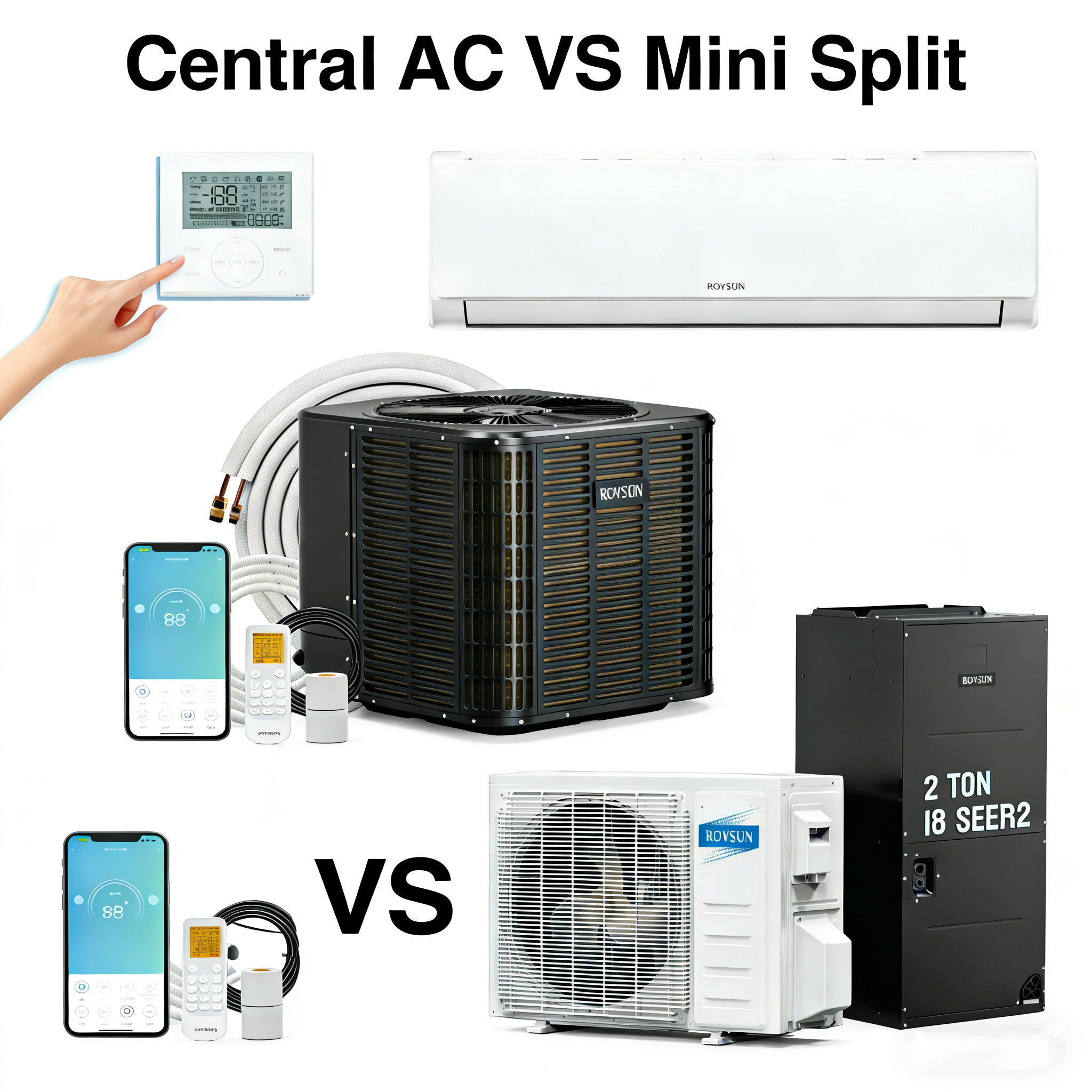
When picking a home climate control system, central air conditioners and heat pumps are top choices—both cool effectively, but differ in functionality, efficiency, and climate suitability. Here’s a concise breakdown to help you choose based on your home, budget, and local weather.
What Are They?
1. Central Air Conditioner
Two types exist for full climate control:
- Traditional central AC: A cooling-only system that distributes chilled air via ductwork (outdoor condenser + indoor evaporator coil), relying on a separate furnace for winter heating.
- Modern heat pump-integrated central AC: An upgraded dual-function model that combines central AC’s duct-based whole-home cooling with heat pump technology for heating—no separate furnace needed, delivering consistent 冷暖 (cooling + heating) in one system.
All central ACs use ductwork for even air distribution, making them ideal for whole-home climate control.
2. Mini Split Heat Pump
A standalone all-in-one heating/cooling system that moves heat (instead of generating it) via a reversing valve: cools like an AC in summer (expels indoor heat) and heats in winter (pulls outdoor heat indoors). Available as ducted (works with existing home ducts) or ductless mini-splits (perfect for homes without ducts, or zone-specific control).
Key Differences at a Glance
| Feature | Central Air Conditioner | Heat Pump |
|---|---|---|
| Function | Traditional: Cooling only
Upgraded: Heating + cooling (heat pump-integrated)
|
Heating + cooling (one system, all models) |
| Efficiency Ratings | SEER2 (14–20) for cooling
|
SEER2 (14–20) (cooling) + HSPF2 (8–12) (heating) |
| Climate Fit | All climates:
|
Best for mild/moderate winters (lows ≥20°F/-7°C); cold-climate models work to -5°F/-20°C (may need backup heat in extreme cold) |
| Ductwork | Requires ductwork (all models) | Ducted (uses existing ducts); ductless (no ducts needed—flexible zone control) |
| Upfront Cost | Traditional: Lower (add-on to existing furnace/ducts)
|
Higher (ductless) / Mid-range (ducted); premium for cold-climate models |
| Operating Cost | Traditional: Higher (separate heating system)
|
Lower in mild climates; cold-climate models slightly higher (if backup heat is used) |
Which Should You Choose?
Go with Central AC If:
- You have existing ductwork and want whole-home uniform cooling/heating (choose upgraded heat pump-integrated for all-in-one, traditional if you already have a reliable furnace).
- You prefer duct-based airflow (eliminates hot/cold spots in large homes) and want a system that blends with your home’s existing HVAC setup.
Go with a Heat Pump If:
- You live in a mild/moderate climate (unbeatable energy efficiency for year-round use).
- Your home has no ductwork (ductless mini-splits avoid expensive duct installation, with zone control for individual rooms).
- You’re renovating or adding a room (flexible ductless setup for targeted climate control).
- You want cold-climate versatility (premium heat pump models work to -5°F/-20°C, no separate furnace needed).
Opt for a Dual-Fuel System (Heat Pump + Furnace) If:
You live in a region with extreme cold winters—the heat pump handles mild weather efficiently, and the furnace provides backup heat for frigid temps, balancing efficiency and reliability.
Quick FAQ
-
Do modern central ACs offer heating?
Yes! Upgraded heat pump-integrated central ACs combine duct-based cooling with heat pump heating, delivering all-in-one climate control without a separate furnace.
-
Is a heat pump better than an upgraded central AC?
It depends on ductwork: upgraded central ACs are better for homes with existing ducts (seamless integration), while heat pumps offer flexibility (ducted/ductless) for duct-free homes.
-
What’s the biggest downside of heat pumps?
Standard models have reduced heating efficiency in extreme cold (below 20°F/-7°C); cold-climate models fix this but cost more upfront.
-
Can a heat pump replace a traditional central AC + furnace?
Yes! In mild-cold climates, a ducted heat pump is a direct replacement, offering the same whole-home airflow as central AC with built-in heating.
Final Takeaway
Gone are the days of central AC being cooling-only—upgraded heat pump-integrated central ACs now deliver all-in-one duct-based, making them a great choice for homes with existing ductwork. Traditional central ACs still work for those with a reliable furnace, while heat pumps (ducted/ductless) offer unbeatable flexibility for duct-free homes or zone control.
For cold climates, a dual-fuel system is the sweet spot, and for mild regions, either an upgraded central AC or heat pump will deliver long-term energy savings and year-round comfort. Choose a high-quality, properly sized system (like ROVSUN’s heat pump-integrated central ACs) for the best performance.
https://www.rovsun.com/collections/central-air-conditioners