
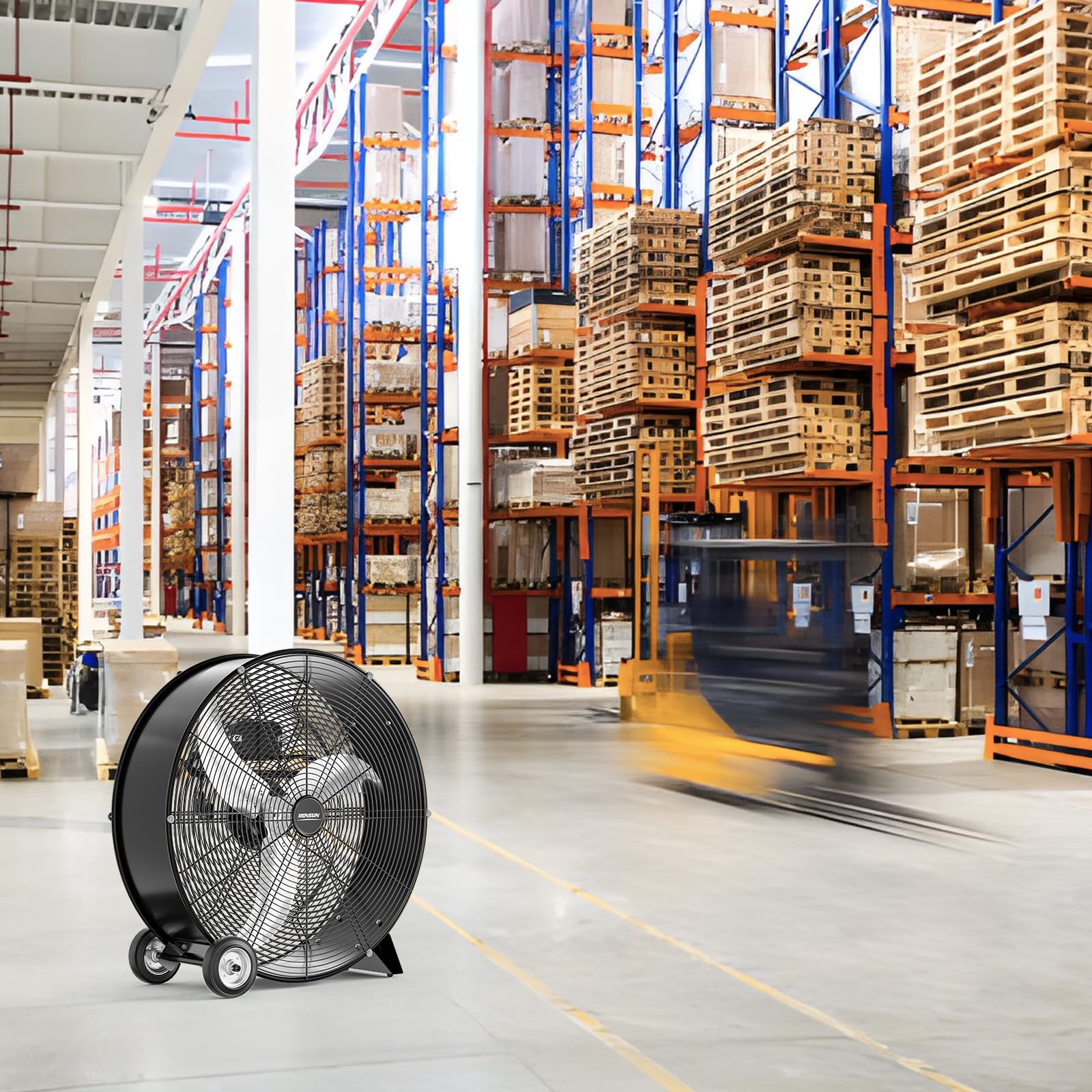
Selecting the right industrial electric fan is not about picking the biggest or cheapest option. The wrong choice leaves your workshop stuffy, reduces worker productivity, and drives up electricity bills. To make a smart decision, focus on five key factors based on your actual needs.
Step 1: Define Your Core Cooling Needs
Start by asking: do you need whole-space air circulation or spot cooling for specific areas?
-
For large, open spaces (e.g., factories, warehouses with ceilings over 6 meters): Consider HVLS (High-Volume, Low-Speed) fans. These large-diameter fans move a vast amount of air slowly, creating a natural breeze effect. A single unit can cover over 1,000 square meters, providing noticeable comfort without blowing papers off desks.
-
For spot cooling at specific workstations (e.g., assembly lines, repair bays): Choose portable and directional fans. Drum fans or pedestal fans are excellent choices here. Models like the ROVSUN 30" Drum Fan (230W) or 30" Pedestal Fan (220W) deliver high-velocity airflow directly where your team is working, offering immediate relief.
-
For outdoor or semi-outdoor areas (e.g., patios, loading docks): A misting fan combines airflow with a fine water mist, which can lower the surrounding temperature by several degrees. Options like a 26" or 30" Industrial Misting Fan (260W–300W) are specifically designed for these environments.
Step 2: Choose the Right Fan Type
Understanding the common fan types will help narrow your options. Here is a quick guide based on products available:
| Fan Type | Best For | Key Feature |
|---|---|---|
| Drum Fan | Large industrial spaces, warehouses, workshops | High-velocity airflow, heavy-duty, portable |
| Pedestal Fan | Versatile use in garages, factories, larger rooms | Height-adjustable, wide oscillation, sturdy base |
| Floor Fan | Smaller areas, gyms, home offices | Compact, portable, high-velocity direct cooling |
| Wall-Mounted Fan | Spaces with limited floor area | Saves floor space, adjustable tilt, fixed installation |
| Misting Fan | Outdoor patios, pools, loading docks | Combines airflow with mist for enhanced cooling |
| Tower Fan | Offices, reception areas, modern spaces | Space-saving, sleek design, quieter operation |
Step 3: Check Motor and Power Efficiency
The motor is the heart of any fan. For continuous industrial use, look for fans with heavy-duty, continuously rated motors that can run for long hours without overheating. The power consumption (wattage) directly impacts your electricity bill.
-
For strong, localized airflow in a workshop, a 20" Pedestal Fan (110W) or 24" Drum Fan (130W) offers a good balance of power and efficiency.
-
For broader coverage in a large garage, a 30" Pedestal Fan (220W) or 30" Drum Fan (230W) provides the extra muscle needed.
-
If energy saving is a top priority, consider the new generation of ECM (Electronically Commutated) motors when available, as they can cut energy use by up to 40% compared to traditional AC motors.
Step 4: Assess Portability and Mounting
How you install the fan is just as important as its power.
-
Portable (Floor/Drum/Pedestal): Ideal if you need to move the fan between different work areas. Look for models with sturdy bases and, for drum fans, convenient handles.
-
Fixed (Wall-Mounted): A space-saver, perfect for garages or workshops where floor space is at a premium. Ensure the mounting bracket is secure and the fan's tilt angle is adjustable for directing airflow.
-
Misting Fans: Usually available as portable or wall-mounted units. Choose based on your space layout. A wall-mounted misting fan (e.g., 20" or 26") keeps the floor clear, while a pedestal misting fan offers flexibility.
Step 5: Factor in Safety and Environment
Finally, consider where the fan will operate.
-
Dusty, humid, or greasy environments: Choose fans with sealed bearings and totally enclosed motors that resist dust and moisture ingress. Blade guards should be tightly spaced to prevent accidents.
-
Safety features: Always look for UL-listed or equivalent safety certification. For ceiling or wall-mounted fans, confirm they include safety cables or anti-drop devices for fall protection.
-
Noise levels: While industrial fans are not silent, advanced blade designs can reduce turbulence and noise. If the fan is near a workspace where conversation or alarms are critical, test its sound level first.
Final Thoughts: Match the Fan to the Job
Selecting an industrial electric fan is about matching the tool to the task. By clearly defining your space, choosing the right type, checking motor efficiency, and ensuring safe installation, you will find a fan that improves comfort and productivity.
For a reliable starting point, explore trusted industrial brands like ROVSUN. Their range includes diverse models from compact floor fans to powerful drum and pedestal fans. Remember, the best fan is the one that fits your specific work environment and budget, keeping your team cool and efficient all year round.